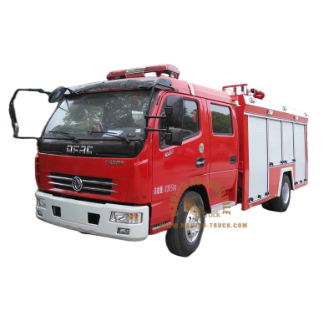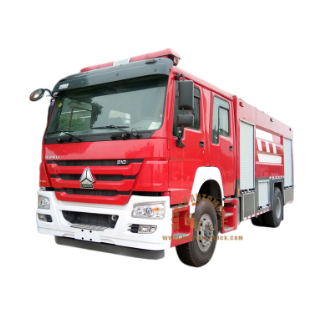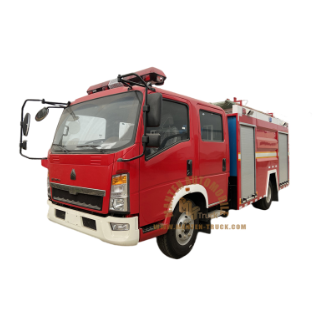
Firefighting truck water cannons are composed of a base, inlet pipe, rotating body, water collecting pipe, jet regulation ring, handle, and locking mechanism. The gun body can be rotated horizontally and vertically, and can be fixed in position. The cannon has a wide pressure range, with a far range and infinitely adjustable direct flow to 90° blossom and water mist jet. Its light weight, small size, complete functions, and good fire extinguishing effect are the biggest characteristics of the gun. Foam guns mainly consist of a handle, base, inlet pipe, rotating body, locking device, foam spray system, and rotating mechanism.
Water cannons should be used within the specified pressure range.
Adjust the swing range, jet, and elevation angle according to the fire site.
Place the fire fighting truck water cannon in an appropriate position at the disaster site and connect it to the fire hose for water supply.
The integrity and mobility of the cannon should be checked regularly. If any fasteners become loose, they should be repaired promptly to keep the cannon in good working order.
During water spraying operations, release the locking screw, adjust the jet direction and angle, and then increase the pressure to the appropriate level.
Turning the jet regulation ring can switch the water stream from direct flow to blossom or from blossom to direct flow.
After each use, the cannon should be sprayed with clean water for a period of time and then drained of water.
Absolutely do not stand in front of the muzzle while the water cannon is spraying.
Firefighting truck water cannons should not be used to extinguish fires involving live electrical equipment to avoid electrical shock.
The rotating parts of the water cannon should be regularly lubricated to ensure flexibility of movement.
When not in use, the firefighting truck water cannon should be positioned horizontally and covered with rainproof material.
Adjust the swing range, jet, and elevation angle meticulously, in a coordinated and scientific way.
The water supply pressure must be maintained above 4 kilograms.
The integrity and mobility of the cannon should be checked regularly, and if any fasteners become loose or deformed, they should be repaired promptly to keep the cannon in good working order.
Water cannons should be used within the specified pressure range.
The ball valve on the firefighting truck water cannon should be opened or closed within the specified pressure range to avoid damaging the ball valve and sealing parts.
The rotating parts of the water cannon should be regularly lubricated with grease to ensure flexibility of movement.
Clean water should be used to avoid damaging the ball valve or clogging the firefighting truck water cannon.
Firefighting truck water cannons should not be used to extinguish fires involving live electrical equipment to avoid electrical shock.
After each use, the cannon should be sprayed with clean water for a period of time and then drained of water. In winter, in severely cold areas, there must be no water in the water cannon to avoid freezing and damage.
Personnel entering the disaster site must wear appropriate protective equipment to prevent injury.
Try to avoid external factors affecting the swinging of the water cannon to prevent damage.
After completing the task, the firefighting truck water cannon and everything surrounding it must be thoroughly cleaned.
A quick-disconnect rain cover can be used to protect water cannons in rainy weather.
The fire fighting truck water cannon is an important firefighting equipment for long-distance firefighting, and is divided into two major series: fire water cannons (PS) and foam fire cannons (PP). Fire water cannons use water as a medium to extinguish fires from a distance for general solid materials. Foam fire cannons spray air foam to extinguish class A, B, and C liquid fires from a distance. Fire water cannons use water as a medium to extinguish fires from a distance.
|
|
|
MANTEN New Customized LPG Truck Has Been Officially DeliveredJune 1, 2024Manten successfully delivered a batch of customized Dongfeng 24,000 liter LPG refueling trucks to help customers achieve efficient transportationIn the latest development, Manten's highly customiz...view
Foam Fire Truck Firefighting Operation ProceduresJune 6, 2025Concept of Foam Fire TruckA foam fire truck is a type of fire truck equipped with a fire pump, water tank, foam concentrate tank, and devices that mix water and foam concentrate. It also features a fo...view
Do You Know the Development Trend of Truck?July 12, 2023The formal name of trucks is load-carrying vehicles, which are a form of automobile used for carrying goods and commodities, including dump trucks, tractor trucks, off-road and off-road area offroadin...view
The Advantages and Key Considerations of Bitumen Truck in Modern ConstructionDecember 24, 2025Bitumen Truck Advantages and ConsiderationsAs global infrastructure development accelerates, the demand for efficient asphalt transportation solutions continues to grow. Bitumen trucks have become ind...view
Safety Precautions for LPG Gas Tanker TruckDecember 24, 2024The improper transportation of hazardous chemicals can have significant consequences. Accidents involving liquefied petroleum gas (LPG) tank trucks differ from general hazardous chemical transportatio...view
What Are the Reasons for the Puncture of the Sanitation Garbage Dump Truck?May 22, 2023The lifespan of tires is actually a false proposition because it can vary from 50,000 to 200,000 kilometers. Truck tires are the epitome of hard work and are a symbol of endurance and resilience. For ...view