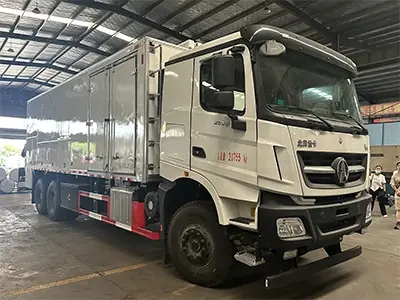
The negative pressure ambulance system consists of a casing, filtration system, disinfection system, exhaust system, and control system. It ensures that the air pressure inside the vehicle is lower than the outside atmospheric pressure, allowing air to flow freely from outside to inside the vehicle. The air inside the vehicle is treated to neutralize harmful substances before being expelled, creating a fixed airflow field in the negative pressure cabin. Air flows from the clean zone (medical personnel area) to the infection source zone (patient area).
Simultaneously, the airflow control within the vehicle ensures that clean air enters from above and is expelled from below, keeping the air around the medical staff's head clean and sterile, while the air around the patient is polluted and then expelled through the exhaust and filtration system. The expelled air is filtered to be clean and sterile. This design reduces the risk of cross-infection between medical personnel and patients and prevents wider infection among the population, achieving true "safe isolation".
The filtration system is used to filter contaminated air containing viruses. Viruses primarily spread in the air through droplets and droplet nuclei, which require efficient air filters for removal. The negative pressure ambulance system uses high-efficiency filter disinfectors to prevent the leakage of polluted air from the medical cabin.
The design of the disinfection system can refer to air disinfectors. Common air disinfection methods include ultraviolet disinfection, ozone disinfection, and plasma disinfection. Since the negative pressure system in ambulances is mainly designed to expel the exhalations of infected patients, the installation position is often close to the patient's head. Ozone disinfection is unsuitable as ozone can directly damage alveolar epithelial cells and irritate respiratory mucosa, making inhalation of ozone into the lungs strictly prohibited. Therefore, ultraviolet disinfection is more suitable for the negative pressure ambulance system.
The negative pressure cabin must accommodate a negative pressure isolation stretcher, medical cabinets, and specialized medical equipment, making it very compact in structure and space. The negative pressure ambulance system is best designed using a negative pressure unidirectional flow, i.e., forced exhaust and natural intake, using the pressure difference between the inside and outside to ventilate. This design features simplicity, ease of operation, and does not take up space inside the cabin.
The control of the ambulance negative pressure purification and disinfection system primarily involves system startup and shutdown, pressure difference adjustment, and pressure difference over-limit alarm. Variations among different manufacturers, vehicle models, and processors result in differences in the sealing performance of each negative pressure ambulance. Therefore, the negative pressure system must be adaptable, universal, and adjustable.
Guardrail Cleaning Trucks in Industrial and Commercial SpacesJanuary 26, 2024Guardrail cleaning is a vital task that is often overlooked in the maintenance of industrial and commercial spaces. Dirty guardrails not only create an unsightly appearance but can also pose serious s...view
Bulk Compression Garbage Trucks Exported to KyrgyzstanAugust 29, 2023We are pleased to announce that Manten Group has successfully exported 15 high-quality compression garbage truck sets to Kyrgyzstan recently, and this transaction marks our further expansion and devel...view
Basic Characteristics of Aerial Ladder Fire TruckJuly 12, 2023Aerial ladder fire truck is equipped with a hydraulic lifting platform for firefighters to rescue people, extinguish fires, and save valuable goods on high-rise buildings, tall facilities, oil tanks a...view
The Use of Isuzu Army Trucks in Disaster Relief Operations: A Manten PerspectiveDecember 25, 2023IntroductionIn the face of natural disasters and emergencies, the need for reliable, robust, and versatile vehicles cannot be overstated. Manten, a leading provider of military vehicles, has been at t...view
Innovations in Live Fish Transportation: Introducing Manten's Live Fish Transport TruckJune 14, 2023IntroductionThe transportation of live fish is a critical aspect of the aquaculture industry. Ensuring the safe and efficient transfer of fish from hatcheries to markets or other aquaculture facilitie...view
Milk Tanker Semi-Trailer Leads the Revolution in Fresh Milk TransportationJune 1, 2024In the field of fresh milk transportation, a new semi-trailer milk tanker is spearheading a technological revolution. This vehicle not only meets the stringent requirements of fresh milk transportatio...view